Inside the garden
Follow Boboli as a planned landscape
Boboli climbs a steep hillside, with two main axes: one from the palace up past the Amphitheatre and Neptune Fountain to the top, and the long Viottolone running downhill to the Isolotto. Pick a few anchors on each and follow the routes between them.
01Must see
Start at the Amphitheatre
Directly behind Pitti Palace, a former stone quarry was shaped into a horseshoe-shaped amphitheatre for Medici court spectacles. At its centre stand an ancient Egyptian obelisk, brought from Rome in 1790, and a huge granite basin from the Roman baths.
Look upwardNotice how the terraces turn rough hillside into a stage facing the palace, the garden’s first great set piece.
02Must see
Step inside the Buontalenti Grotto
Near the Pitti Palace exit, Bernardo Buontalenti’s Grotta Grande (1583–1593) is a fantasy cave of stalactites, shells and painted animals. Casts of Michelangelo’s unfinished “Prisoners” sit in the first chamber (the originals are at the Accademia). Giambologna’s Venus stands in the innermost room.
Detail to findLook for the shepherds and animals emerging from the painted walls, which blur the line between sculpture and nature.
03Upper garden
Climb to the Neptune Fountain and Abundance
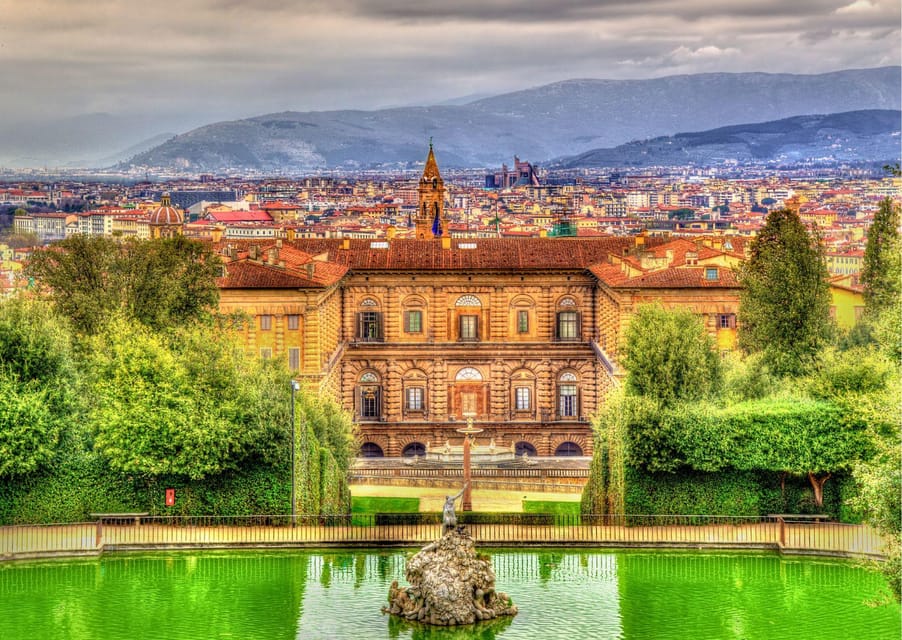
Above the Amphitheatre, Stoldo Lorenzi’s bronze Neptune (1565–1568) stands on a rock in a large pool. Florentines nicknamed it the “Fork Fountain”. Higher still, the statue of Abundance, begun by Giambologna and finished by Pietro Tacca, looks back over the palace and the city.
Check firstWorks can restrict access around the Neptune area, so choose the best available viewpoint rather than detouring.
04Best view
Look out from the Kaffeehaus
This Rococo pavilion of 1775–1776, with its green copper dome, was built for the Habsburg-Lorraine grand dukes. From its terrace, the view stretches across the Duomo, the Palazzo Vecchio tower and the Florentine hills.
Simple approachTake the climb slowly and use the terraces as rest points. There is no guaranteed café here.
05Signature route
Walk the Viottolone
This long, steep avenue of cypresses and holm oaks was laid out in the 1630s by Giulio and Alfonso Parigi, when the garden was extended toward Porta Romana. Statues line the way down to the Isolotto.
Better viewing rhythmWalk part of it downhill, then turn back once to see how the avenue frames the upper garden.
06Signature view
Circle the Isolotto
At the end of the Viottolone, an oval moat surrounds an island garden of lemon trees and flowerbeds. At its centre is Giambologna’s Ocean Fountain (the original statue is in the Bargello Museum), and sculptures of Perseus and Andromeda rise from the water.
Why it mattersThe whole basin was designed as one stage set. Read it as a landscape, not a single statue.
07Earlier layer
Seek out the Grotto of Madama
Built in 1553–1555 for Eleonora di Toledo, the first Medici duchess of Pitti, this small grotto of stalactites and animal sculptures is Boboli’s earliest. It shows the idea that Buontalenti later developed on a grander scale.
Compare the twoSee it with the Buontalenti Grotto in mind to trace how the garden’s language developed.
08Quick stop
Meet the Bacchus Fountain
By the exit near the Pitti courtyard, Valerio Cioli’s playful 1560 statue shows Morgante, a dwarf at Cosimo I’s court, riding a tortoise as Bacchus. It is one of the most photographed statues in Boboli.
Good timingIt is right by the exit, so save it for the end of your visit.